
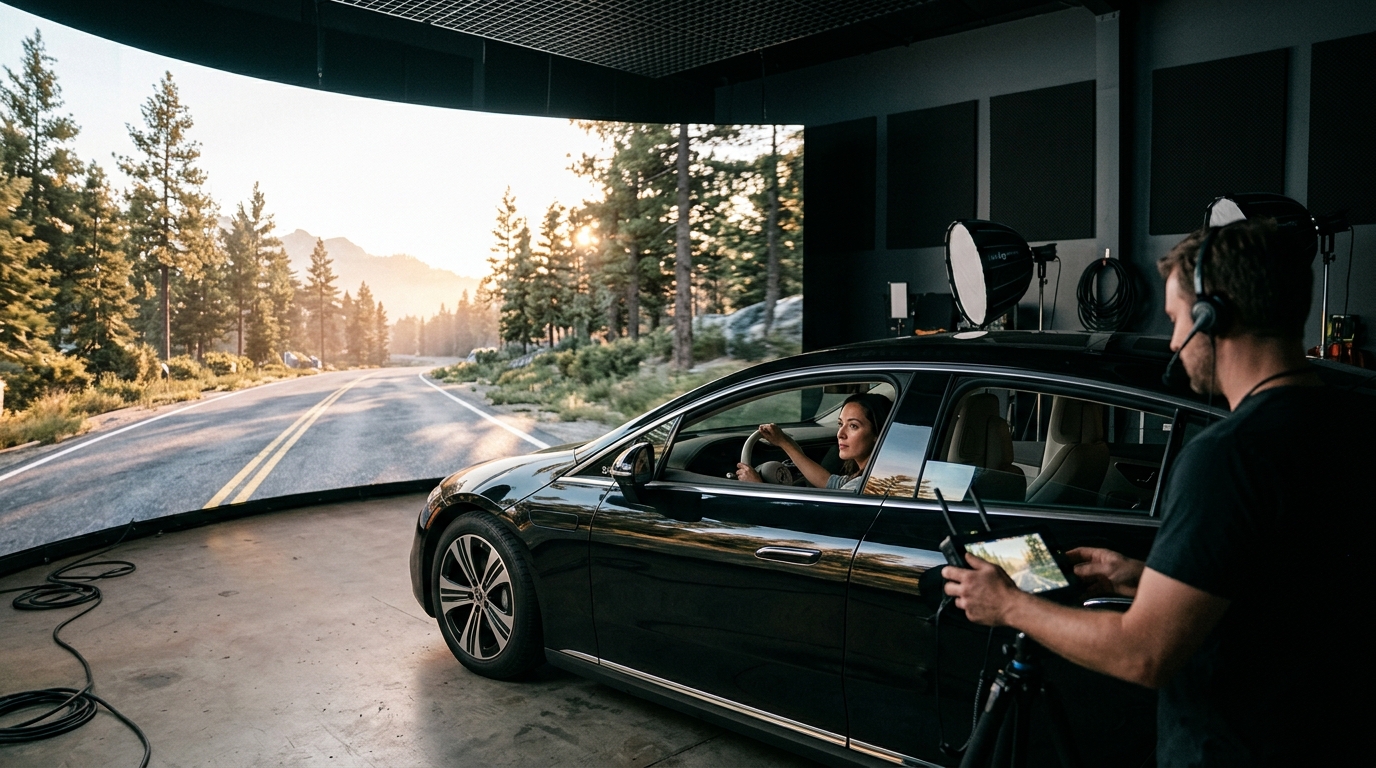
Traditional car process trailers are expensive, logistically heavy, and often limit creative freedom. According to industry data from the Georgia Film Office, virtual production adoption has surged, with over 400 productions utilizing the state's facilities in recent years. This shift highlights a critical industry move toward efficiency. By leveraging LED volume walls, filmmakers can eliminate the need for physical trailers entirely. This approach reduces overhead costs while delivering photorealistic backgrounds in real time.
Why Switch to LED Volume for Car Scenes?
The traditional process trailer relies on a large screen mounted to a vehicle. This setup requires complex rigging, heavy machinery, and significant power generation. It also limits the director to a single, fixed perspective. LED volume walls offer a dynamic alternative. The environment surrounds the vehicle, providing 360-degree lighting and background options.
One major advantage is the elimination of green screen spill. Green screens often cause color contamination on actors and vehicles, requiring extensive post-production cleanup. LED walls emit light that matches the background, reducing this issue significantly. This results in cleaner footage and faster turnaround times.
Additionally, the ability to change environments instantly is transformative. A director can shoot a desert scene in the morning and a snowy mountain landscape in the afternoon. This flexibility is impossible with physical trailers. The technology allows for real-time adjustments to lighting and weather conditions.
The Role of Unreal Engine in Virtual Sets
Unreal Engine is the core technology powering modern LED volume walls. It renders high-fidelity 3D environments in real time. This rendering happens at frame rates that match the camera's shutter speed, ensuring no motion blur artifacts. The engine calculates how light bounces off the LED panels and reflects onto the car and actors.
Virtual production involves creating digital assets that mimic real-world physics. These assets include roads, skies, and distant mountains. The Unreal Engine processes these assets to create a seamless illusion of depth. This depth is crucial for car scenes, where parallax movement must look natural.
The integration of Unreal Engine allows for interactive lighting. As the virtual sun moves across the sky, the lighting on the car changes in real time. This eliminates the need for large HMI lights or reflectors. The result is a more authentic look that matches the background perfectly.
Technical Setup for Car Process
Setting up a car scene in an LED volume requires precise calibration. The first step is positioning the vehicle on a turntable or stationary platform. The camera must be synchronized with the LED wall's rendering engine. This synchronization ensures that the background moves correctly relative to the camera's perspective.
Lighting calibration is the next critical step. The LED wall's brightness must match the ambient light in the studio. If the wall is too bright, it will wash out the car's details. If it is too dim, the scene will look flat. Technicians use light meters to measure the intensity and color temperature of the LED output.
Camera tracking is another essential component. The camera's position and orientation are tracked in real time. This data is sent to the Unreal Engine, which adjusts the virtual camera's view accordingly. This ensures that the background remains stable and does not jitter or shift unexpectedly.
Finally, the crew must manage the car's interior lighting. Since the LED wall provides the primary light source, interior lights may need adjustment. This ensures that the actors' faces are properly illuminated without looking unnatural. The goal is to create a cohesive look that blends the physical and virtual elements seamlessly.
Cost Analysis: Trailer vs. Volume
Comparing the costs of process trailers and LED volume walls reveals significant differences. Process trailers require rental fees, fuel, and a large crew. They also incur costs for location permits and travel. These expenses add up quickly, especially for multi-day shoots.
LED volume walls offer a different cost structure. The primary expense is the studio rental fee. This fee often includes access to the Unreal Engine team and technical support. While the hourly rate may be higher than a trailer, the overall production time is often shorter.
Here is a comparison of the two methods:
| Factor | Process Trailer | LED Volume Wall |
|---|---|---|
| Setup Time | Hours to Days | Minutes to Hours |
| Location Flexibility | Fixed | Infinite |
| Post-Production VFX | High | Low |
| Lighting Control | Limited | Real-Time |
The reduction in post-production costs is a major benefit. With LED walls, the background is captured in-camera. This eliminates the need for rotoscoping and compositing. The savings in post-production can offset the higher studio rental costs.
Key Takeaways
- LED volume walls eliminate the need for physical process trailers, reducing logistical complexity.
- Unreal Engine provides real-time rendering, ensuring accurate lighting and perspective.
- Virtual production reduces post-production VFX costs by capturing backgrounds in-camera.
- Georgia is a leading hub for virtual production, hosting over 400 productions recently.
- 24ATL Studios offers specialized car process services using Unreal Engine technology.
- Real-time lighting adjustments allow for dynamic scene changes without physical props.
- Eliminating green screen spill results in cleaner footage and faster turnaround.
Frequently Asked Questions
What is a process trailer?
A process trailer is a specialized vehicle equipped with a large screen. It displays pre-recorded footage to simulate motion for actors inside the car. This method is traditional but limited in flexibility.
How does LED volume replace a process trailer?
LED volume walls use real-time rendered 3D environments. They surround the car, providing dynamic lighting and backgrounds. This eliminates the need for pre-recorded footage and physical screens.
Is Unreal Engine necessary for virtual car scenes?
Yes, Unreal Engine is the industry standard for virtual production. It renders high-fidelity graphics in real time. This ensures that lighting and perspective match the camera's movement accurately.
Can I change the environment during filming?
Yes, one of the main benefits of LED volume is the ability to change environments instantly. Directors can switch from day to night or from city to desert without stopping production.
What are the cost benefits of using LED volume?
LED volume reduces post-production VFX costs. It also saves time on location scouting and travel. The overall production budget is often lower despite higher studio rental fees.
Where can I shoot car scenes with LED volume?
24ATL Studios in Atlanta, GA, offers specialized car process services. They utilize Unreal Engine technology to create immersive virtual sets for film and commercials.
How is lighting managed in an LED volume?
Lighting is managed through the LED wall's output and studio ambient lights. The wall's brightness is calibrated to match the virtual scene. This ensures realistic reflections on the car and actors.
Start Your Virtual Production Today
Ready to elevate your next car scene? Contact 24ATL Studios to schedule your shoot. Our team is ready to help you frame your vision with cutting-edge Unreal Engine technology. Visit our team page to meet the experts behind the production. Explore our props and services to see how we can support your project. Frame your shoot with us today.