
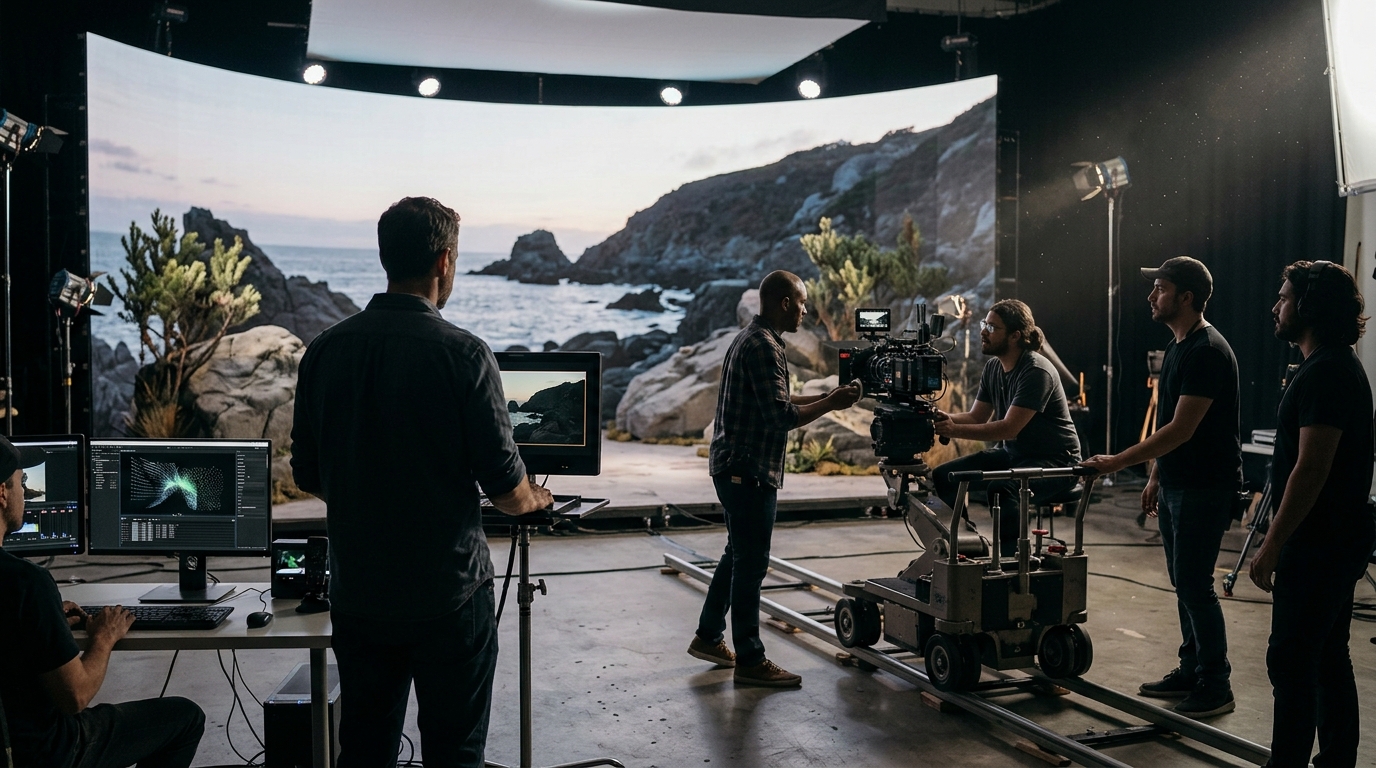
Virtual production has fundamentally altered the landscape of modern filmmaking, with LED volume stages becoming the standard for high-end commercial and narrative projects. According to recent industry analyses, the global virtual production market is projected to expand significantly through 2026, driven by the demand for real-time rendering capabilities and reduced post-production timelines. This shift is not merely a trend but a structural evolution in how content is created, allowing creators to visualize final outputs on set rather than in post. For production companies in Atlanta and beyond, understanding the technical and operational nuances of these stages is critical to maximizing return on investment.
Understanding LED Volume Technology
An LED volume is not simply a large screen. It is an immersive, three-dimensional environment where high-resolution LED panels form the walls and floor of a soundstage. This technology relies on real-time 3D engines to render backgrounds that respond dynamically to camera movement. The result is accurate lighting, reflections, and shadows that interact naturally with the actors and physical props on set.
Virtual production is the practice of using real-time computer graphics to create visual effects during filming. This definition distinguishes it from traditional green screen workflows, where backgrounds are added later. The primary advantage of an LED volume is the elimination of green spill, which often requires extensive keying and color correction in post-production. By capturing the correct lighting and reflections in-camera, productions can save significant time and budget.
For directors and cinematographers, the ability to see the final composite in real-time allows for immediate creative adjustments. This immediacy reduces the guesswork often associated with traditional VFX-heavy shoots. The technology enables filmmakers to travel to worlds with the press of a button, offering unparalleled flexibility in location scouting and set design.
Key Selection Criteria for Your Stage
When evaluating an LED volume stage for your next project, several technical and operational factors must be considered. The quality of the LED panels, the resolution of the content, and the integration with your preferred real-time engine are paramount.
Resolution and Pixel Pitch
The pixel pitch, or the distance between the centers of adjacent pixels, determines the image clarity. For close-up shots, a smaller pixel pitch is essential to prevent visible pixelation. High-resolution stages ensure that the background remains sharp and realistic, maintaining the illusion of depth and scale. Productions requiring high-detail visuals, such as automotive commercials or sci-fi narratives, must prioritize stages with superior panel density.
Camera Tracking and Latency
Seamless integration between camera movement and background rendering is critical. Advanced stages utilize high-precision camera tracking systems to update the rendered environment in real-time as the camera moves. Low latency ensures that there is no perceptible delay between the camera's position and the corresponding change in the background. This synchronization is vital for maintaining immersion and avoiding motion sickness in the audience.
Audio and Acoustic Treatment
While the visual aspect is dominant, the acoustic properties of the stage are equally important. LED panels can reflect sound, potentially creating unwanted echoes or standing waves. A well-designed volume stage includes acoustic treatment to ensure clean audio capture without the need for extensive post-production sound design. This is particularly important for dialogue-heavy scenes or musical performances.
Unreal Engine Integration and Workflow
Unreal Engine is the industry standard for real-time virtual production. It provides the tools necessary to create complex, photorealistic environments that can be rendered in real-time. The integration between the LED volume hardware and the Unreal Engine software is seamless, allowing for rapid iteration and customization of scenes.
Virtual set production involves the creation of digital assets and environments that are displayed on the LED walls. These assets must be optimized for real-time rendering to maintain high frame rates and low latency. Studios that specialize in Unreal Engine technology can provide custom-tailored environments that are fully adaptable to the specific needs of a production.
The flexibility of Unreal Engine allows for the use of background plates or environments that can be modified on the fly. This capability is particularly useful for creating unique lighting scenarios or adjusting the time of day during filming. The ability to change the environment instantly can streamline the shooting process and reduce the need for multiple location setups.
Cost-Benefit Analysis: Volume vs. Traditional Methods
One of the most compelling arguments for using an LED volume stage is the potential for cost savings. While the upfront cost of renting a volume stage may be higher than a traditional green screen, the overall production budget can be significantly reduced.
| Factor | LED Volume Stage | Traditional Green Screen |
|---|---|---|
| Location Costs | Reduced or eliminated | High (travel, permits, logistics) |
| Post-Production VFX | Mitigated due to in-camera VFX | High (keying, compositing, cleanup) |
| Lighting Accuracy | Real-time, accurate reflections | Requires extensive setup and correction |
| Creative Flexibility | High (instant environment changes) | Low (fixed background, limited changes) |
| Actor Performance | Enhanced by immersive environment | Challenging due to lack of context |
By cutting production costs in half through savings on locations, car process trailers, and green screen spill, productions can allocate more resources to other critical areas. The simplicity of VFX in the post-processing cycle further accelerates the delivery timeline, allowing for faster turnaround times for clients.
24ATL Studios: A Premier Production Environment
24ATL Studios stands at the forefront of this technological revolution, offering a state-of-the-art LED volume wall studio in Atlanta, GA. The studio is equipped with cutting-edge Unreal Engine technology, enabling filmmakers to create immersive experiences that rival the quality of Disney’s Mandalorian.
The team at 24ATL Studios, including owners Nick, Alex, and Matt, brings a wealth of expertise in creative direction, financial oversight, and legal strategy. This comprehensive approach ensures that every project is executed with precision and efficiency. Nick oversees the creative and operational aspects, driving innovation in the virtual production space. Alex manages capital oversight and risk control, protecting budget integrity. Matt aligns legal strategy with creative execution, ensuring projects are protected and impactful.
24ATL Studios offers a range of services, including pre-production planning, post-production support, and specialized car process capabilities. The studio’s custom-tailored Unreal Engine environments are fully adaptable, allowing for the creation of unique visual imagery and lighting scenarios. Whether you are producing a film, television show, commercial, or music video, 24ATL Studios provides the infrastructure and expertise to elevate your production.
For more information on how 24ATL Studios can support your next project, visit the Frame Your Shoot page to connect with the team directly.
Key Takeaways
- LED volume stages provide real-time, accurate lighting and reflections, reducing post-production VFX needs.
- Unreal Engine integration is essential for creating dynamic, responsive virtual environments.
- Cost savings are achieved through reduced location expenses and streamlined post-production workflows.
- 24ATL Studios offers specialized services including car process and custom Unreal Engine assets.
- High-resolution panels and low-latency camera tracking are critical for immersive productions.
- The global virtual production market is expanding rapidly, with significant growth expected through 2026.
- Direct communication with studio owners ensures tailored creative and operational support.
Frequently Asked Questions
What is an LED volume stage?
An LED volume stage is an immersive soundstage where high-resolution LED panels form the walls and floor, displaying real-time rendered backgrounds that respond to camera movement.
How does Unreal Engine enhance virtual production?
Unreal Engine allows for the creation of photorealistic, real-time 3D environments that can be rendered instantly on LED walls, enabling directors to see the final composite during filming.
Is virtual production more expensive than traditional methods?
While rental costs may be higher, virtual production often reduces overall budget by eliminating location fees and minimizing post-production VFX work, potentially cutting costs in half.
What types of productions benefit most from LED volumes?
Films, television shows, commercials, and music videos that require complex environments, accurate lighting, or rapid scene changes benefit significantly from LED volume technology.
Can LED volumes be used for car process shoots?
Yes, specialized LED volume stages like those at 24ATL Studios offer dedicated car process capabilities, allowing for realistic driving scenes without the need for physical trailers or location changes.
How does 24ATL Studios support pre-production?
24ATL Studios provides custom-tailored Unreal Engine environments and adaptable scenes/assets to fit your concept, ensuring seamless integration from pre-production through post-production.
What is the role of the creative director in virtual production?
The creative director oversees the artistic vision and operational execution, ensuring that the virtual environment aligns with the director’s intent and meets technical requirements.
Frame Your Shoot
Ready to elevate your production with cutting-edge LED volume technology? Contact 24ATL Studios today to discuss your project needs and explore how our Unreal Engine virtual set production can streamline your workflow. Visit our Frame Your Shoot page to get started, or reach out directly to our team for a personalized consultation.