
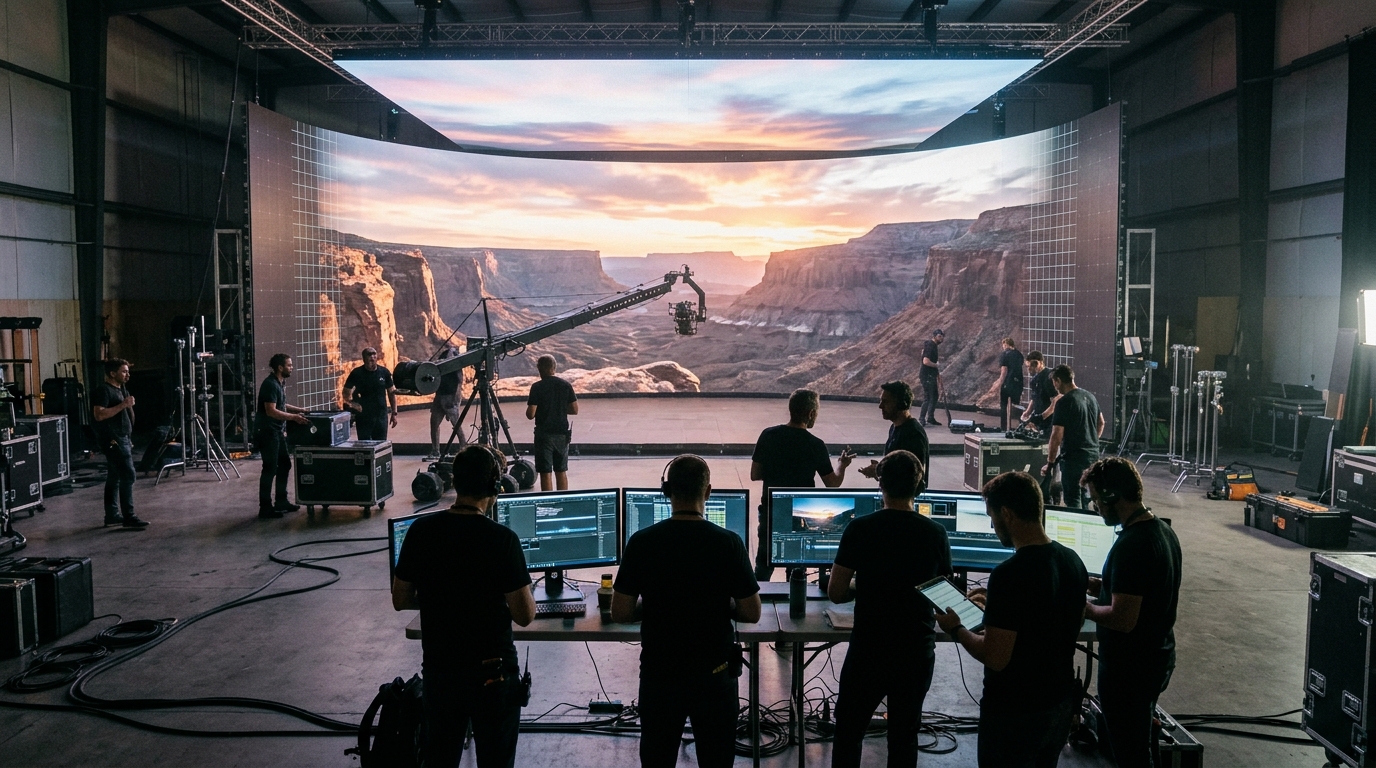
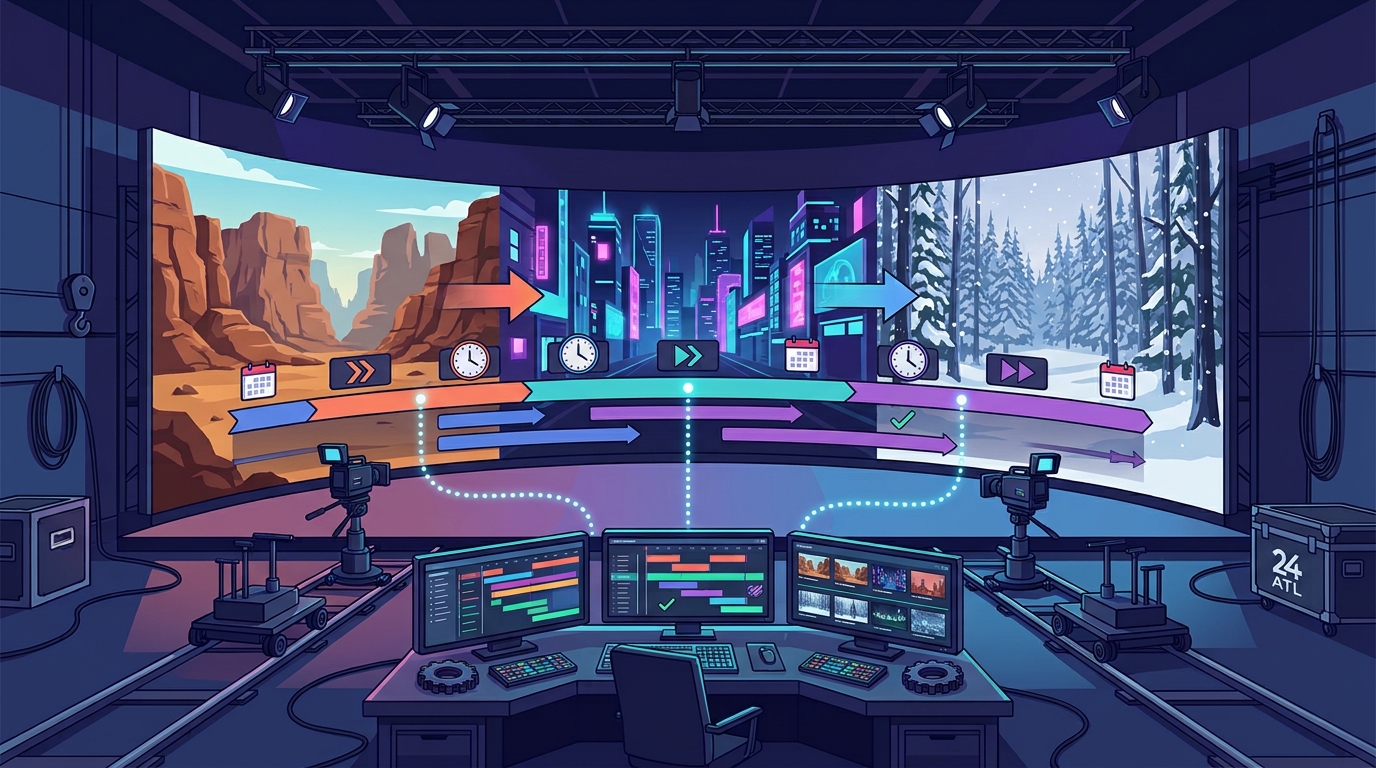
Planning a shoot day that moves between several virtual sets requires rigorous pre-production asset management and precise technical handoffs. By treating each virtual environment as a distinct physical location, producers can eliminate traditional travel time and lighting resets. This approach allows a single production day to cover multiple distinct visual narratives without the logistical drag of physical location changes. At 24 ATL Studios, we specialize in streamlining these transitions to maximize creative output while minimizing downtime.
The Economics of Virtual Transitions
Traditional location shooting incurs significant hidden costs related to travel, permits, and equipment transport. Virtual production eliminates these variables by keeping the physical set static while changing the digital background. This shift fundamentally alters the math of a production day. Instead of losing four hours driving to a new site, a crew can spend that time executing complex camera moves in a new digital environment. The efficiency gain is not just about speed; it is about budget preservation. When you remove the need for physical location scouting and setup, you free up capital for higher-end talent or post-production work. This economic model is particularly effective for high-concept narratives that require diverse settings within a single story arc. For additional details, review the 24ATL Studios LED Volume.
Pre-Production Asset Pipeline
Success in multi-set virtual production depends entirely on the readiness of digital assets before the camera rolls. A virtual set is a pre-rendered or real-time 3D environment that must be optimized for the specific hardware of the volume wall. If assets are not optimized, the rendering engine may struggle, causing frame drops or visual artifacts during the shoot. Producers must work closely with virtual production technicians to ensure that every environment is loaded, lit, and tested in advance. This pre-production phase is where the real time savings occur. By resolving technical issues in the weeks before the shoot, the actual filming day becomes a matter of execution rather than troubleshooting. The goal is to have a seamless library of environments ready to be swapped in with minimal technical intervention.
Optimizing the Technical Handoff
The transition between virtual sets is a technical event that requires precise coordination. A technical handoff is the process of switching the rendering engine from one environment to another while maintaining camera tracking accuracy. This process must be rehearsed to ensure it happens within seconds, not minutes. The crew must understand the specific triggers and software workflows that allow for instant environment swaps. In a well-run studio, this transition is as smooth as a scene change in a traditional shoot. The director can call for a new location, and the volume wall updates in real-time. This immediacy allows for creative flexibility, enabling the director to try different environments for the same scene if the initial choice does not work. The ability to iterate quickly is a major advantage of virtual production over physical location shooting.
Lighting and Color Continuity
Maintaining visual consistency across different virtual sets is a critical challenge. Lighting continuity is the practice of ensuring that the light source and color temperature remain consistent across different digital environments. In a physical location, lighting is often dictated by the time of day and weather. In a virtual set, lighting is controlled by the rendering engine, allowing for precise manipulation. However, this control requires careful planning to avoid jarring shifts in mood or tone. The colorist and director of photography must collaborate to define a lighting strategy that works across all planned environments. This ensures that the final edit feels cohesive, even if the scenes take place in vastly different digital worlds. By planning lighting in pre-production, the crew can avoid the time-consuming process of re-lighting a physical set for each new location.
Case Study: The Atlanta Advantage
Key Takeaways
- Virtual production eliminates travel time and physical setup costs, allowing for more scenes per day.
- Pre-production asset optimization is critical to ensuring smooth transitions between virtual sets.
- Technical handoffs must be rehearsed to minimize downtime during environment swaps.
- Lighting continuity requires careful planning to maintain visual cohesion across different digital environments.
- Real-time rendering allows for creative flexibility, enabling directors to iterate on environments during the shoot.
Frequently Asked Questions
How long does it take to switch between virtual sets?
With proper pre-production and technical preparation, switching between virtual sets can take less than a minute. The rendering engine loads the new environment while the camera tracking system maintains its position. This speed allows for rapid scene changes that would be impossible with physical locations.
Do I need to re-light the set for each virtual environment?
No, the lighting is controlled by the rendering engine, not physical lights. However, you must plan the lighting strategy in pre-production to ensure consistency. The virtual environment includes its own lighting data, which is applied to the actors and props in real-time.
Can I change the time of day in a virtual set?
Yes, you can change the time of day instantly by adjusting the lighting parameters in the rendering engine. This allows you to shoot a scene at noon and then at midnight without waiting for the actual sun to move. This flexibility is one of the primary advantages of virtual production.
What is the main cost saving in virtual production?
The main cost saving is the elimination of travel, permits, and physical set construction. By keeping the physical set static, you avoid the expenses associated with moving equipment and crew to multiple locations. This allows you to allocate budget to other areas of the production.
Is virtual production suitable for all types of films?
How does 24 ATL Studios support multi-set shoots?
24 ATL Studios provides a one-stop solution for virtual production, including pre-production planning, technical execution, and post-production support. Our team works with you to optimize assets and plan transitions, ensuring a smooth and efficient shoot day.
Conclusion
Planning a shoot day that moves between several virtual sets is a matter of preparation and precision. By leveraging the capabilities of real-time rendering and optimized asset pipelines, producers can achieve a level of efficiency that is unattainable with traditional methods. The key is to treat the virtual environment as a physical location, with all the planning and coordination that entails. At 24 ATL Studios, we are committed to helping you navigate these complexities. Our team of experts is ready to assist you in planning your next multi-set shoot, ensuring that every transition is seamless and every frame is perfect. To plan your visit, contact our team today to discuss how we can elevate your production with our virtual production services. Learn more: 24ATL Studios LED Volume.