
In-Studio vs. On-Location Car Scenes: Process Trailer Alternatives
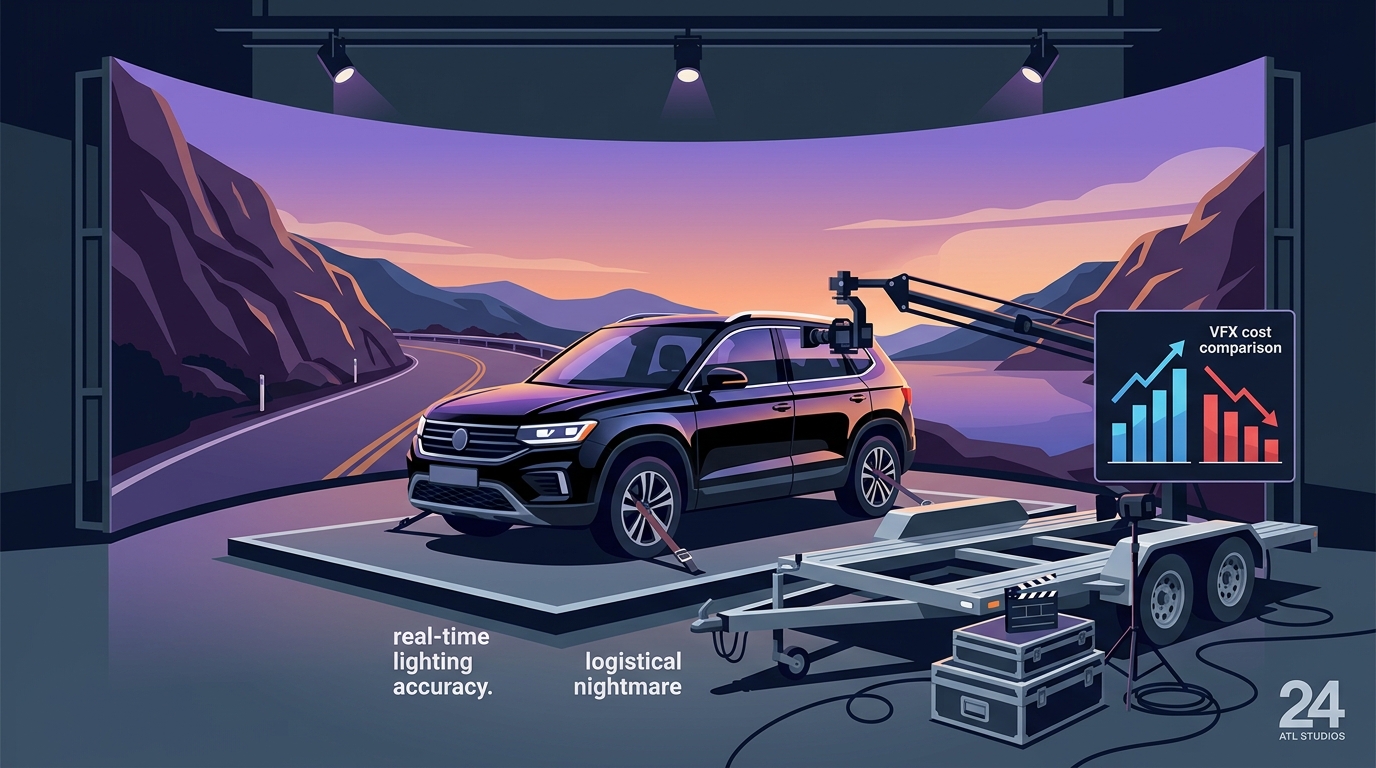
Traditional automotive filming has long relied on the logistical nightmare of process trailers, yet modern virtual production is rapidly shifting that paradigm. According to recent industry analyses of virtual production adoption, studios utilizing LED volume walls report a significant reduction in post-production VFX costs compared to traditional green screen or on-location shoots. This shift is not merely a trend but a fundamental change in how visual fidelity and budget efficiency intersect. Production teams are now prioritizing in-studio environments that offer real-time lighting accuracy over the unpredictable variables of outdoor filming.
Understanding the Process Trailer Legacy
The process trailer has been the industry standard for decades. It is a specialized vehicle equipped with cameras, lighting rigs, and safety equipment designed to film cars while they are moving. This method allows for dynamic shots where the background appears to move relative to the vehicle. However, the operational complexity is immense. It requires a large crew, multiple support vehicles, and precise coordination to ensure safety and continuity.
Process trailers are expensive to maintain and operate. They require specialized drivers and camera operators who are trained in high-speed filming techniques. The cost of renting these units, combined with the logistical expenses of transporting them to various locations, can quickly escalate a production budget. Furthermore, the weather is a constant variable. Rain, wind, or poor lighting conditions can halt production entirely, leading to costly delays.
Despite these drawbacks, process trailers offer a level of realism that is difficult to replicate. The physical interaction between the car and the environment, such as wind resistance and road vibration, is authentic. However, as technology advances, the gap between practical realism and virtual fidelity is narrowing. This is where in-studio solutions like those offered by 24ATL Studios come into play, offering a viable alternative that maintains visual integrity while reducing logistical burdens.
The In-Studio LED Volume Advantage
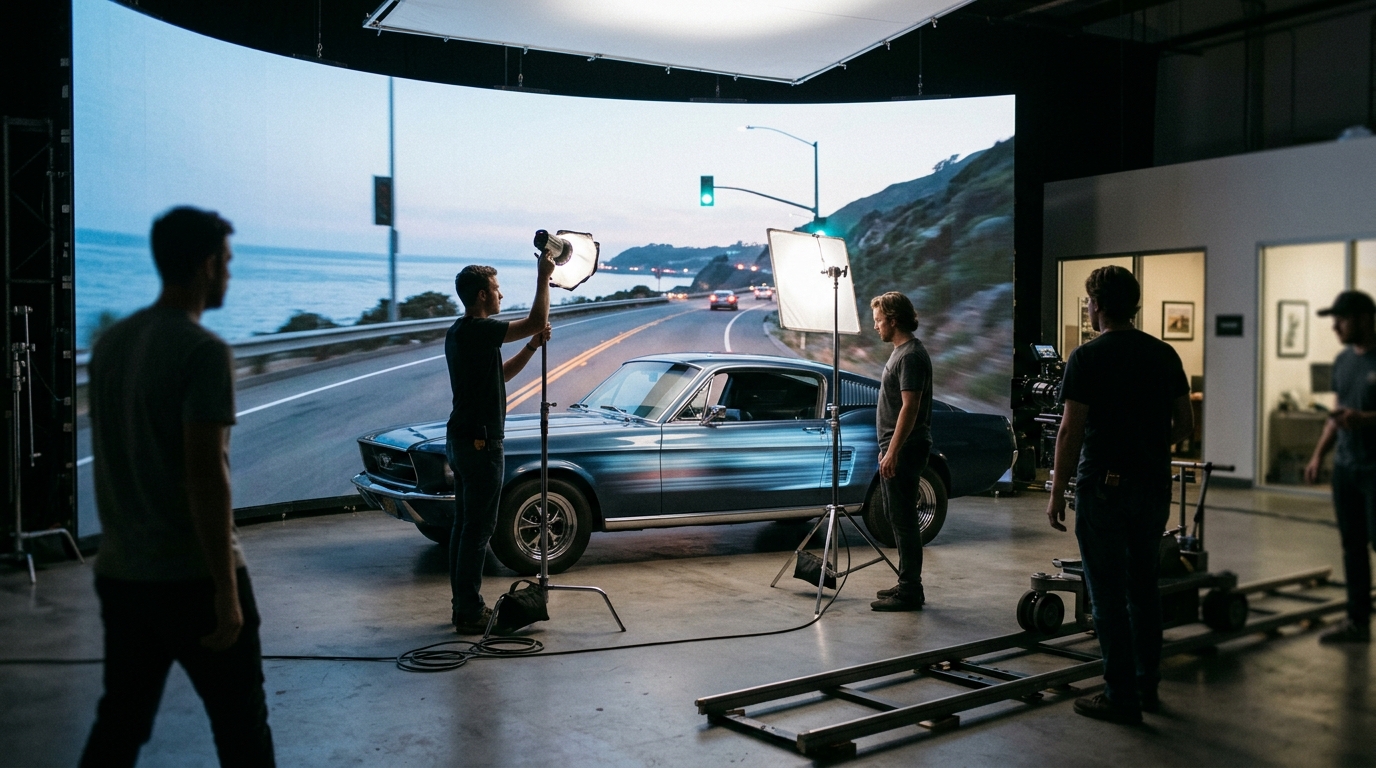
In-studio filming using LED volume walls represents a paradigm shift in automotive production. This technology uses high-resolution LED panels to display dynamic backgrounds that react in real-time to the camera's position. This creates a seamless integration between the foreground subject and the background environment. The lighting from the LED walls naturally illuminates the car, eliminating the need for complex lighting setups that often fail to match the virtual environment.
One of the primary benefits of this approach is the ability to change locations instantly. A production can move from a desert highway to a city street in seconds without moving the vehicle. This flexibility allows for greater creative exploration and reduces the time spent on location scouting and setup. The Unreal Engine technology used in these studios ensures that the virtual environments are photorealistic and interactive, providing a level of immersion that traditional methods struggle to achieve.
Additionally, in-studio filming offers complete control over the environment. Weather, time of day, and lighting conditions are entirely under the director's control. This consistency is crucial for maintaining visual continuity across multiple shots. It also allows for safer filming conditions, as there are no risks associated with high-speed driving or unpredictable outdoor elements. The immersive soundstage at 24ATL Studios is designed to provide this unparalleled lighting experience, streamlining the immersion of your production in seconds.
On-Location Filming Challenges
On-location filming for car scenes presents a unique set of challenges that can impact both the creative and financial aspects of a production. One of the most significant issues is the unpredictability of natural light. The sun moves across the sky, changing the quality and direction of light throughout the day. This requires constant adjustment of reflectors, diffusers, and artificial lighting to maintain consistency. Any mismatch in lighting can result in costly post-production fixes.
Another major challenge is securing permits and managing traffic. Filming on public roads often requires extensive coordination with local authorities, road closures, and traffic control. This can be time-consuming and expensive, especially in urban areas. Additionally, the presence of bystanders and unexpected obstacles can disrupt filming, leading to multiple takes and increased production time. The custom tailored Unreal Engine environments available in-studio eliminate these variables, allowing for uninterrupted shooting.
Environmental factors also play a critical role. Wind, rain, and dust can affect both the equipment and the actors. Protecting sensitive camera gear from the elements requires additional resources and planning. Furthermore, the physical wear and tear on the vehicles being filmed can be significant, especially if the scenes involve high-speed maneuvers or off-road driving. In-studio solutions mitigate these risks by keeping the vehicles stationary while the background moves, preserving the condition of the assets.
Cost and Efficiency Comparison
When comparing the costs of in-studio filming versus on-location shooting, several factors come into play. On-location filming often incurs hidden costs such as permits, insurance, crew travel, and accommodation. These expenses can add up quickly, especially for productions that require multiple locations. In contrast, in-studio filming offers a more predictable cost structure. The primary expenses are the studio rental time and the crew, which are easier to budget and control.
Efficiency is another critical factor. On-location shoots are subject to delays due to weather, traffic, and other external factors. These delays can extend the production schedule, leading to higher labor costs and potential penalties. In-studio filming, on the other hand, allows for a more streamlined workflow. Scenes can be shot in any order, and changes to the environment can be made instantly without the need for physical relocation. This efficiency is particularly valuable in fast-paced commercial productions where time is money.
| Factor | In-Studio LED Volume | On-Location / Process Trailer |
|---|---|---|
| Lighting Control | Real-time, dynamic, consistent | Dependent on natural light, complex setup |
| Location Flexibility | Instant changes, infinite options | Fixed, requires travel and permits |
| Weather Dependency | None, fully controlled environment | High, can cause delays and cancellations |
| Post-Production VFX | Minimal, in-camera integration | Extensive, often required for background replacement |
| Safety | High, stationary vehicle | Variable, depends on speed and environment |
Creative Flexibility and Control
Creative flexibility is a major advantage of in-studio filming. Directors and cinematographers can experiment with different environments and lighting scenarios without the constraints of physical location. This freedom allows for more innovative storytelling and visual styles. For example, a scene can transition from a realistic cityscape to a fantastical landscape seamlessly, something that would be difficult and expensive to achieve on location.
The ability to adjust the virtual environment in real-time also enhances the performance of the actors. They can react to the changing surroundings, creating a more authentic and engaging performance. This interaction is facilitated by the fully adaptable scenes/assets provided by modern virtual production studios. The Mobile Walls feature further expands these possibilities by allowing for unique lighting and visual imagery that can be tailored to the specific needs of the production.
Furthermore, in-studio filming supports a more collaborative workflow. The director, cinematographer, and VFX supervisor can work together in real-time to make adjustments and refinements. This collaborative approach ensures that the final product meets the creative vision while staying within budget and schedule constraints. The pre production and post production support offered by comprehensive studios like 24ATL Studios ensures that every aspect of the production is aligned and optimized.
Key Takeaways
- In-studio LED volume walls reduce post-production VFX costs by providing in-camera integration of backgrounds.
- Process trailers offer authentic physical interaction but come with high logistical and financial overheads.
- On-location filming is subject to weather delays, permitting issues, and unpredictable natural lighting.
- Unreal Engine technology enables real-time, photorealistic environments that react to camera movement.
- In-studio filming allows for instant location changes, enhancing creative flexibility and efficiency.
- 24ATL Studios provides custom tailored Unreal Engine environments and Mobile Walls for unique lighting.
- Virtual production streamlines the workflow from pre-production to post-production, mitigating traditional risks.
Frequently Asked Questions
What is an LED volume wall?
An LED volume wall is a large-scale display system composed of high-resolution LED panels that render dynamic, real-time 3D environments. It is used in virtual production to create immersive backgrounds that interact with the foreground subjects and lighting.
How does Unreal Engine benefit car scene filming?
Unreal Engine allows for the creation of highly detailed and realistic virtual environments that can be manipulated in real-time. This enables filmmakers to change locations, lighting, and weather conditions instantly, providing greater creative control and efficiency.
Is in-studio filming safer than on-location?
Yes, in-studio filming is generally safer because the vehicle remains stationary while the background moves. This eliminates the risks associated with high-speed driving and unpredictable outdoor environments.
Can I change the background during filming?
Absolutely. One of the key advantages of LED volume walls is the ability to change the background environment instantly without moving the camera or the vehicle. This allows for seamless transitions and creative experimentation.
What are Mobile Walls?
Mobile Walls are portable LED wall systems that can be used to create custom lighting setups and visual imagery. They offer flexibility in creating unique visual effects and can be integrated into various production scenarios.
How does virtual production reduce costs?
Virtual production reduces costs by minimizing the need for location scouting, travel, and extensive post-production VFX. The in-camera integration of backgrounds means less work in post, leading to significant savings in time and money.
What types of productions benefit most from this technology?
Film, television, commercials, and music videos benefit most from this technology. Any production that requires dynamic car scenes or complex environments can leverage the efficiency and creative freedom of virtual production.
How do I book a studio session?
You can book a studio session by contacting the studio directly. The team at 24ATL Studios is available to discuss your project needs and provide tailored solutions for your production.
Frame Your Shoot
Ready to elevate your production with cutting-edge virtual technology? Contact 24ATL Studios today to discuss your project requirements. Our team is dedicated to providing innovative solutions that streamline your workflow and enhance your creative vision. From pre-production planning to post-production support, we are here to help you achieve your goals. Frame your shoot with the best in virtual production technology.