
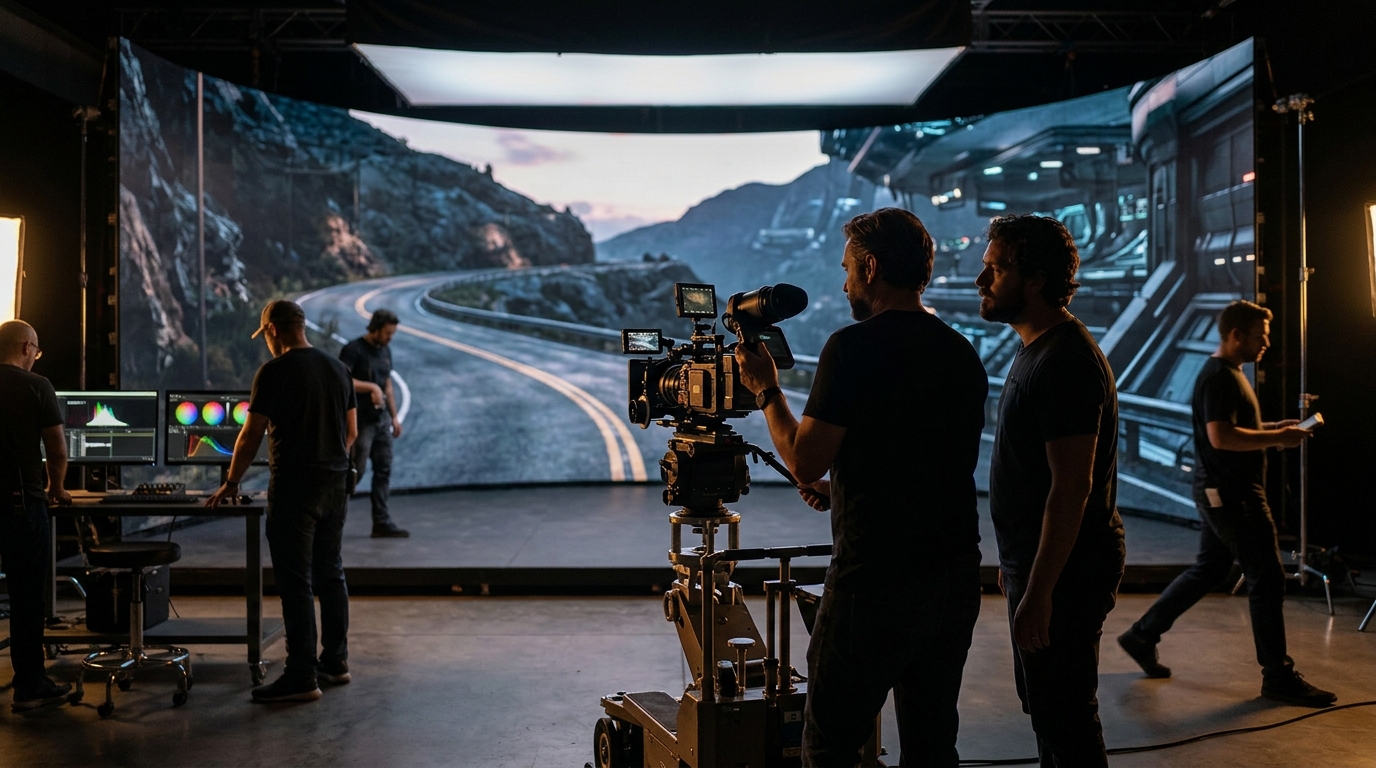
Building a virtual production studio is one of the smartest investments a filmmaker or production company can make right now. But how much does it actually cost? The answer depends on the scale you are targeting. A small LED volume setup can start around $80,000, while a fully equipped, large-scale virtual production facility can exceed $2 million. This guide breaks down every major cost category so you can plan your budget realistically, whether you are building from scratch or considering a more accessible path like renting an existing studio such as 24 ATL Studios in Atlanta.
What Is a Virtual Production Studio?
A virtual production studio is a filmmaking facility that uses LED walls and real-time rendering engines to display photorealistic digital backgrounds on set. Instead of relying on green screens and post-production compositing, directors and cinematographers see the final composite shot in-camera during filming.
The core technology powering most virtual production stages is Unreal Engine by Epic Games, the same platform used on productions like The Mandalorian. At 24 ATL Studios, a 30-foot-wide LED volume wall powered by Unreal Engine gives filmmakers access to this exact technology at Atlanta-level pricing.
LED Volume Wall Costs: The Biggest Line Item
The LED video wall is the single largest expense in any virtual production build. LED video wall panels typically account for 60 to 70 percent of the total studio cost. Pricing varies dramatically based on pixel pitch, size, and manufacturer.
Small-Scale Setups
Budget-friendly manufacturers like Absen offer basic configurations starting around $80,000, making the technology accessible to smaller studios. These work well for medium shots and general virtual production applications.
Mid-Range Installations
Premium systems from companies like ARWALL start around $150,000 for smaller configurations and scale to $2 to $5 million for large-scale installations. These include integrated camera tracking and real-time color calibration.
Enterprise-Grade Volumes
Samsung's professional virtual production solutions range from $200,000 to $4 million, positioned as cutting-edge offerings with comprehensive support.
Unreal Engine and Software Costs
Unreal Engine is a real-time 3D rendering platform that serves as the software backbone of virtual production. The good news: it can be downloaded and used at no upfront cost for many users. For non-gaming commercial applications like film production, Epic Games offers a subscription model at $1,850 per seat per year.
Additional software costs include camera tracking systems (Mo-Sys, Ncam, or OptiTrack), media server software, and content creation tools. Budget $10,000 to $50,000 annually for the full software stack depending on your scale.
Facility and Infrastructure Costs
Beyond the LED wall itself, building a functional studio requires significant infrastructure investment.
Physical Space
You need a soundproofed stage with adequate ceiling height (15 feet minimum), drive-on access, and robust electrical capacity. Studios like 24 ATL Studios offer a 3,087 sq ft soundstage with up to 1,000 amps of power and full soundproofing.
Computing Hardware
A high-performance workstation is the engine of your virtual production studio, equipped with top-tier GPUs and CPUs to handle complex real-time scenes. Expect to invest $15,000 to $60,000 in rendering servers and workstations, plus synchronization hardware.
Supporting Systems
Camera tracking, climate control for LED heat management, rigging, and lighting round out the infrastructure. These supporting systems typically add $50,000 to $200,000 to the build.
Ongoing Operational Costs
Operational expenses are often underestimated. Large LED walls consume 100 to 500 kilowatts during operation, translating to $50 to $250 per hour in electricity alone. Maintenance contracts typically cost 8 to 15 percent of the initial hardware investment annually, covering calibration, component replacement, and software updates.
You will also need skilled operators. An Unreal Engine supervisor, LED technician, and virtual art department can cost $150,000 or more annually in salaries. At 24 ATL Studios, these roles are handled by the in-house team, eliminating the need for productions to hire their own.
Cost Comparison: Building vs. Renting a Virtual Production Studio
| Cost Category | Build Your Own | Rent (e.g., 24 ATL Studios) |
|---|---|---|
| LED Wall | $80,000 - $5,000,000 | Included in rental rate |
| Software Licenses | $10,000 - $50,000/year | Included |
| Facility Build-Out | $100,000 - $500,000+ | N/A |
| Computing Hardware | $15,000 - $60,000 | Included |
| Annual Maintenance | $15,000 - $250,000 | Included |
| Specialized Crew | $150,000+/year | Available on-site |
| Typical Daily Cost | Amortized over years | $300 - $600/hour |
For most independent filmmakers, commercial producers, and mid-budget TV productions, renting eliminates hundreds of thousands in upfront capital risk.
Why Renting a Virtual Production Studio Makes Sense
Most productions do not need a purpose-built LED volume. Renting gives you access to professional-grade technology without the capital burden. A studio like 24 ATL Studios in Doraville, Georgia, offers hourly booking starting at $100/hour for small crews and $300 to $600/hour for typical productions.
The advantage goes beyond the LED wall. 24 ATL operates as a true one-stop production hub with pre-production offices, post-production suites, an extensive prop rental inventory spanning the 1950s through the 2020s, mobile LED walls for car process, and a hard cyc wall for commercial shoots. This integrated workflow means fewer vendors, less logistics, and faster turnaround.
Productions such as Will Trent, Reasonable Doubt, and The Big Door Prize have utilized the team and services tied to 24 ATL, alongside clients like Disney/ABC, Netflix, and Apple TV+.
Key Takeaways
- A virtual production studio build can range from $80,000 for a basic setup to over $5 million for a large-scale facility.
- LED panels represent 60 to 70 percent of total hardware cost.
- Unreal Engine is free for many users, with a $1,850/year subscription for commercial non-gaming applications.
- Ongoing costs including power, maintenance, and crew can exceed $200,000 annually.
- Renting a studio like 24 ATL Studios eliminates upfront capital risk and includes technology, crew, and support services.
- Atlanta's production market offers competitive pricing compared to Los Angeles or New York stages.
- For most productions, renting delivers the same Mandalorian-level technology at a fraction of ownership cost.
Frequently Asked Questions
How much does it cost to build a virtual production studio from scratch?
Total costs range from approximately $80,000 for a minimal LED setup to $2 to $5 million or more for a large, fully equipped facility. The LED wall alone accounts for the majority of the expense, with additional costs for computing hardware, software, facility build-out, and staffing.
Is Unreal Engine free for virtual production?
Unreal Engine can be downloaded at no upfront cost. For commercial non-gaming applications like film and TV production, Epic Games charges $1,850 per seat per year under its subscription model. Productions earning under $1 million may qualify for free access.
How much does it cost to rent a virtual production studio?
Rental rates vary by market. At 24 ATL Studios in Atlanta, rates start at $100/hour for very small crews and $300 to $600/hour for standard productions. Weekly rentals at other facilities can range from $35,000 to $75,000 depending on setup complexity.
What are the ongoing costs of owning a virtual production studio?
Expect annual maintenance costs of 8 to 15 percent of your initial hardware investment. Power consumption for large LED walls runs $50 to $250 per hour of operation. You will also need to budget for software licenses, crew salaries, and climate control.
Can independent filmmakers afford virtual production?
Yes. By renting studio time rather than building, indie filmmakers gain access to professional LED volumes at hourly rates. Studios like 24 ATL Studios specifically cater to independent productions with flexible booking and competitive Atlanta pricing.
What equipment do I need besides the LED wall?
A complete virtual production environment requires high-performance rendering computers, camera tracking systems (Mo-Sys, Ncam, or OptiTrack), media servers, Unreal Engine software, lighting rigs, and a soundproofed stage with adequate power and cooling infrastructure.
Why is Atlanta a good location for virtual production?
Atlanta offers Georgia's generous film tax incentives, a deep production talent pool, and lower facility costs compared to LA or New York. Studios like 24 ATL Studios combine legacy production experience with modern LED volume technology in the heart of this market.
What is 24-frame playback and why does it matter?
24-frame playback is a technique that synchronizes on-screen content to the camera's frame rate, eliminating flicker and banding artifacts. It is essential for capturing realistic screens in-camera, especially for period pieces. 24 ATL Studios maintains an extensive inventory of functional vintage and modern displays optimized for this purpose, viewable in their props catalog.
Ready to Skip the Build and Start Shooting?
Instead of investing millions in your own virtual production facility, book time at a studio that already has everything in place. 24 ATL Studios offers Mandalorian-level LED volume technology, Unreal Engine environments, on-site post-production, and one of the Southeast's largest prop inventories, all under one roof in Atlanta. Contact Nick directly at Nick@24ATL.com or call (404) 578-6271 to discuss your next production.