
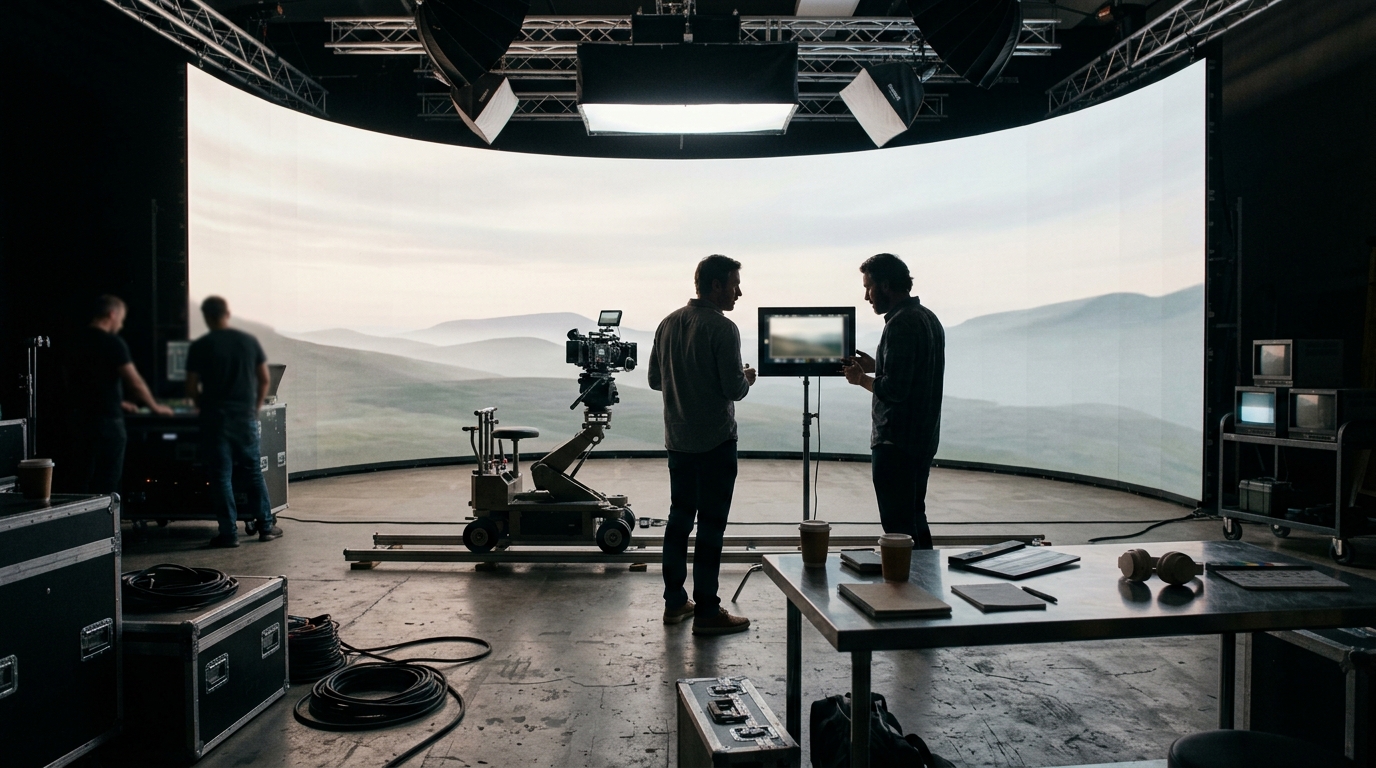
LED volume walls have reshaped how filmmakers create immersive environments, replacing traditional green screens with real-time rendered backgrounds that actors and crews can see during filming. Whether you are producing a streaming series, a commercial spot, or a music video, understanding how to get the most from an LED volume stage is critical. This guide breaks down the essential best practices for shooting on a volume wall, from pre-production planning to on-set execution, so your next project captures cinema-quality results without costly post-production fixes.
What Is a Volume Wall?
A volume wall is a curved or flat array of LED panels that displays real-time 3D environments rendered by a game engine such as Unreal Engine. The term "volume" refers to the three-dimensional nature of the visual space created around performers. Unlike a flat backdrop, the volume responds to camera position through spatial tracking, producing parallax that mimics a real location.
Productions like The Mandalorian popularized ILM StageCraft, which uses this technology at massive scale. Today, mid-sized studios like 24 ATL Studios in Atlanta bring the same Unreal Engine-powered LED volume capability to independent and commercial productions at accessible price points.
Pre-Production Planning for Virtual Production
Virtual production front-loads creative decisions. Digital environments must be built, lit, and tested before the crew arrives on stage. This means pre-production timelines are longer compared to traditional filmmaking, but it pays off with faster shoot days and reduced post-production costs.
Build Your Environments Early
Work with your Unreal Engine supervisor to finalize virtual sets at least two to four weeks before principal photography. At 24 ATL Studios, the in-house Unreal Engine team manages environment builds and technical integration, which streamlines this process.
Prepare Plates If Needed
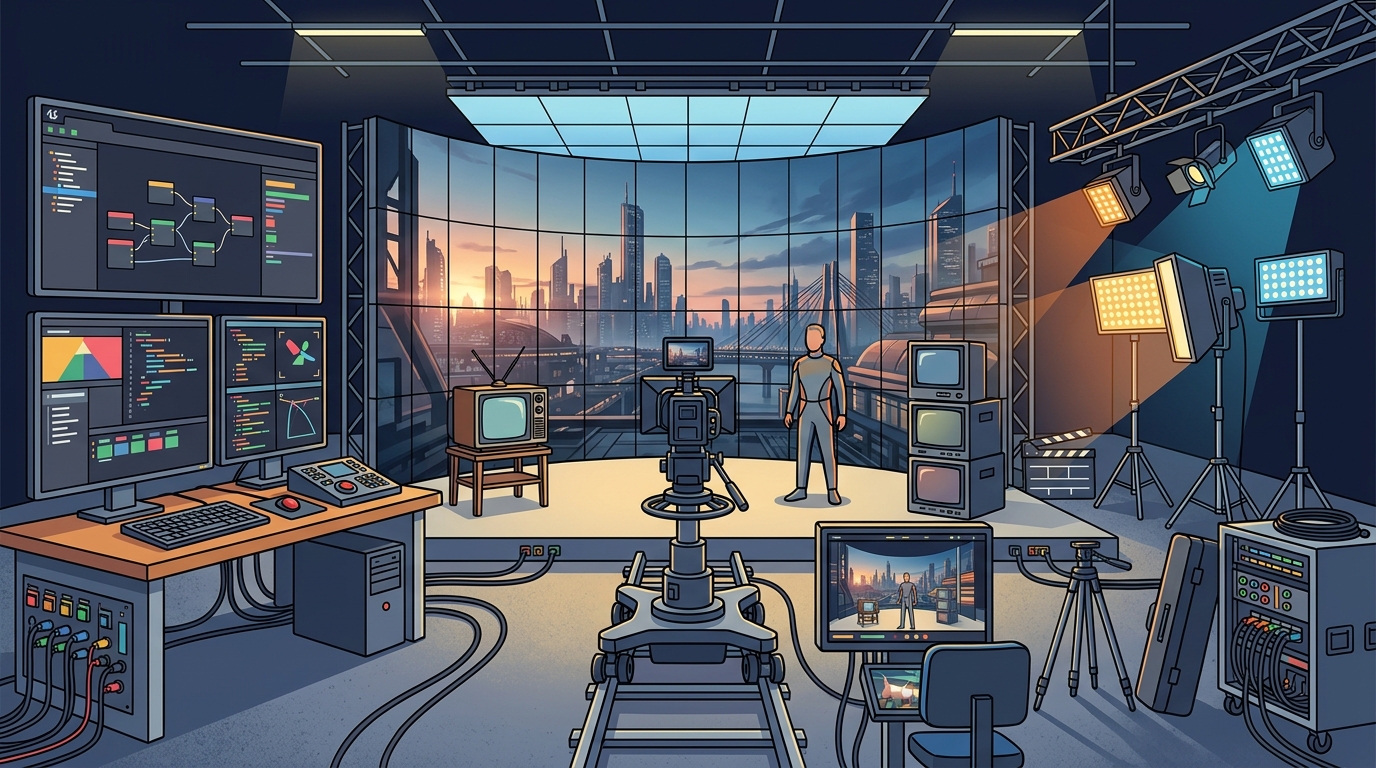
A plate is a filmed background element captured on location, minus actors, that is later displayed on the LED wall. Plates can be shot with a single camera or an array of eight or more synced cameras to achieve up to a 360-degree field of view. High-resolution capture is essential so the imagery holds up at LED panel resolution.
Plan Staging Distances
Determine how much floor space performers need and map out camera positions relative to the wall. This directly affects pixel pitch requirements, lens choices, and lighting placement.
Camera and Lens Selection
Not every camera performs equally on an LED volume. Large-format digital cinema cameras are the preferred choice because their larger sensors produce a naturally shallower depth of field, keeping the LED surface slightly out of focus while the subject remains sharp.
Popular choices include the ARRI Alexa Mini LF and the Sony VENICE 2. Their resolution handles in-camera visual effects (ICVFX) demands, and their shallow depth of field helps prevent visible pixel structure on the wall. Pair these bodies with high-quality optics like the ZEISS Supreme Prime Radiance series for crisp foreground detail and controlled flare characteristics.
If you need camera and production gear, working with a studio that offers on-site rentals can simplify logistics considerably.
Preventing Moiré and Artifacts
Moiré is an interference pattern that appears when the pixel grid of the LED wall interacts with the camera sensor. It is the single most common technical challenge on volume stages.
Understand Pixel Pitch
Pixel pitch is the distance in millimeters between the center of one LED pixel and the center of the next. A common rule of thumb: the minimum distance in meters between the subject and the wall should be no less than the pixel pitch value. For a wall with 2.3mm pixel pitch, keep talent and camera at least 2.3 meters away.
Use Shallow Depth of Field
Shooting at wider apertures (lower f-stop numbers) keeps the LED surface soft. An f/2.8 aperture on a 50mm lens is a common starting point. Large-format sensors make this even easier to achieve.
Consider Anti-Moiré Solutions
Some LED panels use mini LED pixel arrays that reduce moiré compared to standard 3-in-1 SMD configurations. Anti-moiré optical filters can also be placed in front of the lens as a secondary safeguard.
Lighting Integration on the Volume
One of the biggest advantages of LED volume walls is that they function as enormous, programmable light sources. The wall casts realistic ambient light and color onto actors and set pieces, creating natural reflections and interactive illumination that green screens simply cannot replicate.
Match Supplemental Lighting
When adding fill or key lights, use a color meter to measure the ambient color temperature coming from the LED panels. Dial matching values into your LED fixtures. What looks correct to the eye may shift on camera, so always verify with test footage.
Pixel-Mapped Lighting
Advanced volume stages connect overhead LED fixtures to the same server driving the wall, feeding pixel-mapped data that matches on-screen imagery. This creates a fully cohesive lighting environment. Studios offering integrated LED volume wall services can configure these systems as part of the stage package.
Camera Movement and Tracking
Real-time rendering introduces a small amount of latency between camera movement and background response. Faster camera movements make this lag more noticeable.
Smooth, deliberate moves work best. Dolly shots, jib arms, and slider moves are ideal. Handheld work is possible but requires testing and careful coordination with the rendering team. The Mandalorian famously adopted a classical shooting style, favoring dolly moves over handheld, partly for this reason.
Spatial tracking systems such as OptiTrack or Stype use infrared markers on the camera to communicate position and rotation data to Unreal Engine in real time. Calibrating these systems before each shoot day is non-negotiable.
LED Volume vs. Green Screen: Key Differences
| Factor | LED Volume Wall | Green Screen |
|---|---|---|
| On-set visualization | Full environment visible to cast and crew | Blank screen; environment added in post |
| Interactive lighting | Yes, wall provides natural light and reflections | Requires manual recreation in post |
| Post-production VFX time | Significantly reduced | Extensive keying and compositing required |
| Pre-production effort | Higher (environments built before shoot) | Lower up front, higher in post |
| Moiré risk | Requires careful lens and distance management | Not applicable |
| Actor performance | More natural; actors react to visible environment | Requires imagination; harder for emotional scenes |
| Budget profile | Cost-effective for multi-location stories | Cost-effective for single-environment shoots |
For productions needing multiple virtual locations in a single shoot day, an LED volume delivers unmatched efficiency. Studios like 24 ATL Studios pair their 30-foot LED volume wall with a drive-on soundstage, making it easy to combine physical and virtual sets in one location.
Key Takeaways
- Start environment builds in Unreal Engine weeks before principal photography to maximize shoot-day efficiency.
- Use large-format cameras like the ARRI Alexa Mini LF or Sony VENICE 2 for shallower depth of field that hides LED pixel structure.
- Maintain minimum subject-to-wall distance based on pixel pitch (e.g., 2.3mm pitch = 2.3m minimum distance).
- Match supplemental lighting color temperature to the LED wall output using a color meter, not your eyes alone.
- Favor smooth, controlled camera movements over fast handheld work to avoid visible rendering latency.
- LED volumes reduce post-production time and costs while giving actors a more immersive performance environment.
- Choose a studio with integrated virtual production support, like 24 ATL Studios, to streamline every phase from prep through post.
Frequently Asked Questions
What is an LED volume wall used for in film production?
An LED volume wall displays real-time 3D environments behind actors during filming. It replaces green screens by providing visible backgrounds that interact with on-set lighting, reducing post-production VFX work and helping actors deliver more natural performances.
How close can actors stand to the LED wall?
The general rule is that the minimum distance in meters should match the wall's pixel pitch in millimeters. A wall with a 2.8mm pixel pitch, for example, requires actors to stay at least 2.8 meters away to avoid visible pixel patterns on camera.
What cameras work best for LED volume production?
Large-format digital cinema cameras such as the ARRI Alexa Mini LF and Sony VENICE 2 are preferred. Their larger sensors create shallower depth of field, which keeps the LED wall slightly out of focus and prevents moiré artifacts.
Does an LED volume wall replace all post-production work?
No. While LED volumes significantly reduce compositing and keying work, post-production teams still handle color grading, VFX enhancements, and finishing. The technology reduces reliance on green-screen compositing specifically.
How does lighting work on an LED volume stage?
The LED panels themselves act as a massive programmable light source, casting ambient light and color onto subjects. Supplemental fixtures are color-matched to the wall output. Some studios use pixel-mapped overhead LEDs synced to the wall content for fully integrated illumination.
Is LED volume production more expensive than green screen?
Upfront stage costs can be higher, but total production costs are often lower because you save on location travel, post-production compositing, and multiple shoot days. The cost advantage increases for projects requiring many different environments.
Can I use an LED volume wall for commercials and music videos?
Absolutely. LED volumes are increasingly popular for commercials, music videos, and branded content. Studios like 24 ATL Studios offer dedicated packages for shorter-format productions that take full advantage of virtual environments.
What software powers the virtual backgrounds?
Unreal Engine by Epic Games is the industry standard real-time rendering engine for LED volume production. It is the same technology used on The Mandalorian and many other major productions. Unreal Engine renders photorealistic 3D environments that respond to camera tracking data in real time.
Ready to Shoot on an LED Volume?
If you are planning a production that could benefit from virtual environments, contact 24 ATL Studios to schedule a walkthrough of the LED volume wall stage in Doraville, Georgia. The team can help you plan environments, coordinate gear, and execute your shoot from pre-production through post under one roof.