
How to Choose the Right Virtual Production Studio for Your Project
Virtual production is reshaping how films, commercials, and music videos are made. An LED volume wall combined with a real-time engine like Unreal Engine lets you capture final-pixel imagery in-camera, cutting post-production costs and eliminating location headaches. But not every studio delivers the same experience. The global virtual production market was valued at over $3 billion in 2025 and is growing at double-digit rates, which means new facilities are opening fast. Choosing the wrong one can cost you time, budget, and creative quality. This guide walks you through the key factors that separate a great virtual production studio from an expensive disappointment.
1. Understand What Virtual Production Actually Is
Virtual production is a filmmaking technique that integrates real-time computer-generated imagery with live-action footage using LED volume walls and game engines. Unlike green screen compositing, virtual production captures backgrounds in-camera, giving actors and directors immediate visual feedback on set.
This approach was popularized by The Mandalorian and has since expanded into commercials, music videos, and branded content. According to Grand View Research, the global virtual production market is projected to reach $12.25 billion by 2033 at a 20.4% CAGR. Understanding the basics ensures you can ask the right questions when touring studios.
2. Evaluate LED Wall Specifications
The LED volume is the centerpiece of any virtual production studio. Not all walls are created equal. Key specifications to compare include wall size, pixel pitch, refresh rate, color depth, and brightness.
Size Matters for Shot Framing
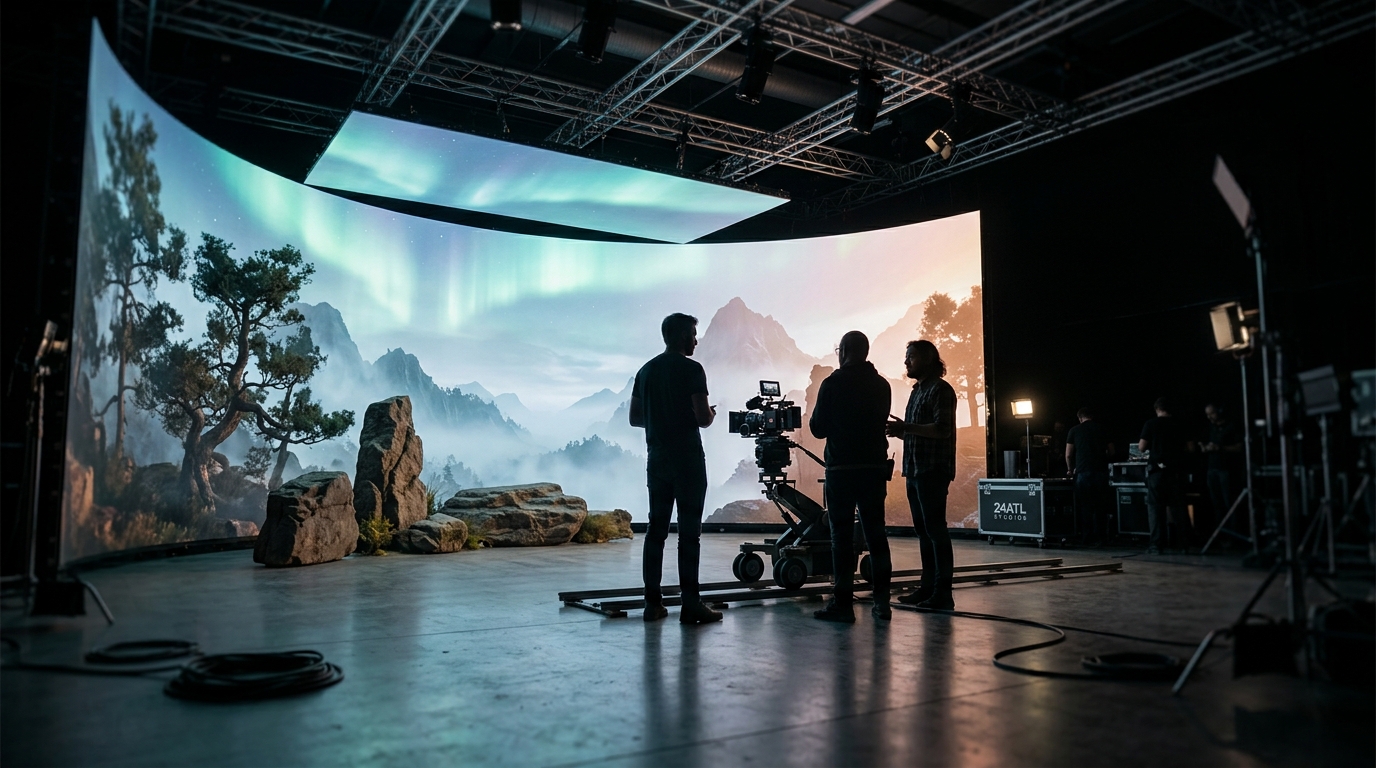
A larger wall gives your cinematographer more freedom for medium and wide shots. For example, 24ATL Studios in Doraville, Georgia operates a 30-foot-wide by 13.6-foot-tall LED volume wall, which is well suited for narrative, commercial, and music video work. Studios with smaller walls may restrict you to close-ups and medium shots only.
Pixel Pitch and Refresh Rate
Pixel pitch is the distance between LED pixels, measured in millimeters. A lower number means higher resolution up close. Refresh rate determines how smoothly the wall renders motion. Look for walls optimized for cinema cameras at 24 frames per second or higher to avoid moire patterns and banding artifacts.
Real-Time Engine Integration
Unreal Engine is the industry standard for rendering photorealistic environments in real time. Confirm that the studio has a dedicated Unreal Engine supervisor or technical team managing virtual environments during your shoot. Studios that treat the engine as an afterthought will slow your production down.
3. Look for an Integrated Production Workflow
The best virtual production studios function as complete production hubs rather than simple room rentals. An integrated workflow means you can handle pre-production planning, principal photography, and post-production editing under one roof.
Look for studios that offer on-site prop rentals, production offices, edit suites, and storage space. When props, stages, and post facilities sit in the same building, you eliminate transport logistics and save hours of production time every day.
Props and 24-Frame Playback
24-frame playback is a specialized service that ensures on-screen monitors and devices display flicker-free content at the camera's frame rate. This is critical for period pieces and any scene featuring visible screens. Studios with large inventories of functional vintage and modern monitors, like camera-ready RetroTech props, save you the hassle of sourcing from multiple vendors.
4. Assess Crew Expertise and On-Set Support
Virtual production is technically demanding. A studio might have gorgeous hardware, but without skilled operators, your shoot will stall. Ask about the team behind the wall.
Key roles to verify include an Unreal Engine supervisor who manages scene loading and real-time adjustments, LED technicians who handle calibration and color matching, and a producer or technical director who coordinates between departments. Studios that provide in-house crew support reduce your need to hire specialized freelancers.
5. Check Facility Size and Logistics
Beyond the LED wall, examine the physical space. Soundstage dimensions, ceiling height, power capacity, and drive-on access all affect what you can accomplish.
| Feature | What to Look For | Why It Matters |
|---|---|---|
| Stage Size | 2,500+ sq ft minimum | Room for sets, crew, and equipment |
| Ceiling Height | 14+ ft floor to grid | Proper lighting rigging clearance |
| Power | 800+ amps available | LED walls and lighting draw significant power |
| Drive-On Access | Roll-up doors or bays | Essential for vehicle scenes and large set pieces |
| Soundproofing | Full acoustic treatment | Clean audio without costly ADR later |
| Production Offices | On-site availability | Keeps your team close to set |
| Parking | Free, ample lot | Crew and equipment trucks need space |
A facility like 24ATL Studios checks these boxes with a 3,087 sq ft soundstage, 15-foot grid height, up to 1,000 amps of power, full soundproofing, and drive-on bays plus over 20 production offices on site.
6. Compare Pricing and Booking Flexibility
Virtual production studio pricing varies widely. Some facilities require multi-day minimums and charge premium day rates. Others offer hourly access, which is ideal for smaller shoots like music videos, commercials, or test shoots.
Ask about hourly rates for small crews, half-day and full-day packages, after-hours and weekend premiums, and whether custom quotes are available for larger productions. Flexible booking is a sign that the studio serves a range of clients rather than only big-budget shows. Check platforms like Peerspace for discounted access, but reach out directly for full-scale production quotes to get the most tailored pricing.
7. Factor in Location Tax Incentives
Where a studio sits geographically can directly impact your bottom line. Georgia, for example, offers one of the most generous film incentive programs in the country. The Georgia Entertainment Industry Investment Act provides up to 30% in transferable tax credits on qualified production expenditures with no annual program cap.
Georgia distributed approximately $887 million in film tax credits in 2025 alone. As of January 2026, standalone post-production companies can also earn a 20% credit on work completed in the state. Shooting at a Georgia-based virtual production studio like 24ATL means you can pair cutting-edge LED volume technology with significant tax savings, a combination that stretches indie and mid-range budgets considerably.
Key Takeaways
- Virtual production captures backgrounds in-camera using LED walls and real-time engines, eliminating traditional green screen compositing.
- Evaluate LED wall size, pixel pitch, refresh rate, and Unreal Engine integration before booking any studio.
- Prioritize studios with integrated workflows that combine stage, props, offices, and post-production in one location.
- Verify that the studio provides experienced on-set crew including an Unreal Engine supervisor and LED technicians.
- Check facility logistics like power capacity, ceiling height, drive-on access, and soundproofing.
- Compare pricing models and favor studios that offer flexible hourly booking alongside full-day rates.
- Factor in state tax incentives. Georgia offers up to 30% transferable credits with no cap on the main production credit.
Frequently Asked Questions
What is a virtual production studio?
A virtual production studio is a facility equipped with LED volume walls and real-time rendering engines that allow filmmakers to project photorealistic digital environments on set, capturing final imagery in-camera instead of relying on green screen compositing in post.
How much does it cost to rent a virtual production studio?
Costs vary widely. Smaller studios may offer rates starting around $100 to $300 per hour for small crews, while large-scale LED stages at major facilities can run several thousand dollars per day. Always request a custom quote based on your project scope.
What is 24-frame playback and why does it matter?
24-frame playback is the process of displaying video content on in-scene monitors at the camera's native frame rate, typically 24 fps, to avoid flicker and banding artifacts. It is essential for any scene where a screen is visible on camera.
Do I need to bring my own Unreal Engine operator?
Not always. Many virtual production studios, including 24ATL Studios, have in-house Unreal Engine supervisors who manage virtual environments and real-time adjustments during your shoot.
What size LED wall do I need?
It depends on your shot list. A wall around 20 to 30 feet wide is sufficient for most narrative, commercial, and music video productions. Wider walls give cinematographers more flexibility for medium and wide shots without revealing wall edges.
Can I use virtual production for commercials and music videos?
Absolutely. Virtual production is increasingly popular for commercials and music videos because it allows rapid environment changes, eliminates location permits, and delivers polished visuals in a fraction of the time a traditional shoot requires.
What are Georgia's film tax incentives?
Georgia provides a 20% base tax credit on qualified production spending of $500,000 or more, with an additional 10% uplift for including a Georgia promotional logo. The credit is transferable and has no annual cap for production, making it one of the most attractive programs in the U.S.
How do I book a virtual production studio in Atlanta?
Start by contacting the studio directly for a custom quote. For 24ATL Studios, you can reach the team at Nick@24ATL.com or call (404) 578-6271. You can also browse availability through platforms like Peerspace for smaller bookings.
Ready to Book Your Virtual Production?
If you are planning a film, commercial, music video, or branded content project and want Mandalorian-level LED volume technology at Atlanta pricing, get in touch with 24ATL Studios today. With a 30-foot LED wall, integrated prop rentals, on-site post-production, and flexible hourly booking, the studio is built to take your project from concept to final cut under one roof. Call (404) 578-6271 or email Nick@24ATL.com to discuss your next production.